Newtonian kinetic energy
Kinetic energy of rigid bodies
In classical mechanics, the kinetic energy of a point object (an object so small that its mass can be assumed to exist at one point), or a non-rotating rigid body depends on the mass of the body as well as its speed. The kinetic energy is equal to 1/2 the product of the mass and the square of the speed. In formula form:

where is the mass and is the speed (or the velocity) of the body. In SI units, mass is measured in kilograms, speed in metres per second, and the resulting kinetic energy is in joules.


For example, one would calculate the kinetic energy of an 80 kg mass (about 180 lbs) traveling at 18 metres per second (about 40 mph, or 65 km/h) as

When a person throws a ball, the person does work on it to give it speed as it leaves the hand. The moving ball can then hit something and push it, doing work on what it hits. The kinetic energy of a moving object is equal to the work required to bring it from rest to that speed, or the work the object can do while being brought to rest: net force × displacement = kinetic energy, i.e.,

Since the kinetic energy increases with the square of the speed, an object doubling its speed has four times as much kinetic energy. For example, a car traveling twice as fast as another requires four times as much distance to stop, assuming a constant braking force. As a consequence of this quadrupling, it takes four times the work to double the speed.
The kinetic energy of an object is related to its momentum by the equation:

where:
- is momentum
- is mass of the body


For the translational kinetic energy, that is the kinetic energy associated with rectilinear motion, of a rigid body with constant mass , whose center of mass is moving in a straight line with speed , as seen above is equal to


where:
- is the mass of the body
- is the speed of the center of mass of the body.
The kinetic energy of any entity depends on the reference frame in which it is measured. However the total energy of an isolated system, i.e. one in which energy can neither enter nor leave, does not change over time in the reference frame in which it is measured. Thus, the chemical energy converted to kinetic energy by a rocket engine is divided differently between the rocket ship and its exhaust stream depending upon the chosen reference frame. This is called the Oberth effect. But the total energy of the system, including kinetic energy, fuel chemical energy, heat, etc., is conserved over time, regardless of the choice of reference frame. Different observers moving with different reference frames would however disagree on the value of this conserved energy.
The kinetic energy of such systems depends on the choice of reference frame: the reference frame that gives the minimum value of that energy is the center of momentum frame, i.e. the reference frame in which the total momentum of the system is zero. This minimum kinetic energy contributes to the invariant mass of the system as a whole.
Derivation
The work done in accelerating a particle with mass m during the infinitesimal time interval dt is given by the dot product of force F and the infinitesimal displacement dx

where we have assumed the relationship p = m v and the validity of Newton's Second Law. (However, also see the special relativistic derivation below.)
Applying the product rule we see that:

Therefore, (assuming constant mass so that dm = 0), we have,

Since this is a total differential (that is, it only depends on the final state, not how the particle got there), we can integrate it and call the result kinetic energy. Assuming the object was at rest at time 0, we integrate from time 0 to time t because the work done by the force to bring the object from rest to velocity v is equal to the work necessary to do the reverse:

This equation states that the kinetic energy (Ek) is equal to the integral of the dot product of the velocity (v) of a body and the infinitesimal change of the body's momentum (p). It is assumed that the body starts with no kinetic energy when it is at rest (motionless).
Rotating bodies
If a rigid body Q is rotating about any line through the center of mass then it has rotational kinetic energy () which is simply the sum of the kinetic energies of its moving parts, and is thus given by:


where:
- ω is the body's angular velocity
- r is the distance of any mass dm from that line
- is the body's moment of inertia, equal to .


(In this equation the moment of inertia must be taken about an axis through the center of mass and the rotation measured by ω must be around that axis; more general equations exist for systems where the object is subject to wobble due to its eccentric shape).
Kinetic energy of systems
A system of bodies may have internal kinetic energy due to the relative motion of the bodies in the system. For example, in the Solar System the planets and planetoids are orbiting the Sun. In a tank of gas, the molecules are moving in all directions. The kinetic energy of the system is the sum of the kinetic energies of the bodies it contains.
A macroscopic body that is stationary (i.e. a reference frame has been chosen to correspond to the body's center of momentum) may have various kinds of internal energy at the molecular or atomic level, which may be regarded as kinetic energy, due to molecular translation, rotation, and vibration, electron translation and spin, and nuclear spin. These all contribute to the body's mass, as provided by the special theory of relativity. When discussing movements of a macroscopic body, the kinetic energy referred to is usually that of the macroscopic movement only. However all internal energies of all types contribute to body's mass, inertia, and total energy.
Fluid dynamics
In fluid dynamics, the kinetic energy per unit volume at each point in an incompressible fluid flow field is called the dynamic pressure at that point.
Dividing by V, the unit of volume:
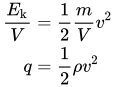
where is the dynamic pressure, and ρ is the density of the incompressible fluid.

Frame of reference
The speed, and thus the kinetic energy of a single object is frame-dependent (relative): it can take any non-negative value, by choosing a suitable inertial frame of reference. For example, a bullet passing an observer has kinetic energy in the reference frame of this observer. The same bullet is stationary to an observer moving with the same velocity as the bullet, and so has zero kinetic energy. By contrast, the total kinetic energy of a system of objects cannot be reduced to zero by a suitable choice of the inertial reference frame, unless all the objects have the same velocity. In any other case, the total kinetic energy has a non-zero minimum, as no inertial reference frame can be chosen in which all the objects are stationary. This minimum kinetic energy contributes to the system's invariant mass, which is independent of the reference frame.
The total kinetic energy of a system depends on the inertial frame of reference: it is the sum of the total kinetic energy in a center of momentum frame and the kinetic energy the total mass would have if it were concentrated in the center of mass.
This may be simply shown: let be the relative velocity of the center of mass frame i in the frame k. Since


Then,

However, let the kinetic energy in the center of mass frame, would be simply the total momentum that is by definition zero in the center of mass frame, and let the total mass: . Substituting, we get:
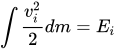


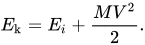
Thus the kinetic energy of a system is lowest to center of momentum reference frames, i.e., frames of reference in which the center of mass is stationary (either the center of mass frame or any other center of momentum frame). In any different frame of reference, there is additional kinetic energy corresponding to the total mass moving at the speed of the center of mass. The kinetic energy of the system in the center of momentum frame is a quantity that is invariant (all observers see it to be the same).
Rotation in systems
It sometimes is convenient to split the total kinetic energy of a body into the sum of the body's center-of-mass translational kinetic energy and the energy of rotation around the center of mass (rotational energy):

where:
- Ek is the total kinetic energy
- Et is the translational kinetic energy
- Er is the rotational energy or angular kinetic energy in the rest frame
Thus the kinetic energy of a tennis ball in flight is the kinetic energy due to its rotation, plus the kinetic energy due to its translation.


Comments
Post a Comment