If a body's speed is a significant fraction of the speed of light, it is necessary to use relativistic mechanics to calculate its kinetic energy. In special relativity theory, the expression for linear momentum is modified.
With m being an object's rest mass, v and v its velocity and speed, and c the speed of light in vacuum, we use the expression for linear momentum  , where
 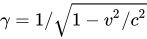 .
.
Integrating by parts yields

Since 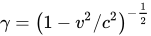 ,
,
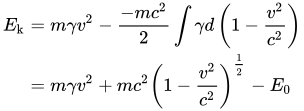
 is a constant of integration for the indefinite integral.
Simplifying the expression we obtain
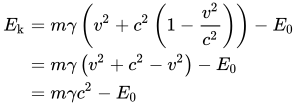
is found by observing that when 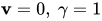 and
and  , giving

resulting in the formula
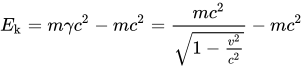
This formula shows that the work expended accelerating an object from rest approaches infinity as the velocity approaches the speed of light. Thus it is impossible to accelerate an object across this boundary.
The mathematical by-product of this calculation is the mass-energy equivalence formula—the body at rest must have energy content

At a low speed (v ≪ c), the relativistic kinetic energy is approximated well by the classical kinetic energy. This is done by binomial approximation or by taking the first two terms of the Taylor expansion for the reciprocal square root:

So, the total energy  can be partitioned into the rest mass energy plus the Newtonian kinetic energy at low speeds.
When objects move at a speed much slower than light (e.g. in everyday phenomena on Earth), the first two terms of the series predominate. The next term in the Taylor series approximation

is small for low speeds. For example, for a speed of 10 km/s (22,000 mph) the correction to the Newtonian kinetic energy is 0.0417 J/kg (on a Newtonian kinetic energy of 50 MJ/kg) and for a speed of 100 km/s it is 417 J/kg (on a Newtonian kinetic energy of 5 GJ/kg).
The relativistic relation between kinetic energy and momentum is given by

This can also be expanded as a Taylor series, the first term of which is the simple expression from Newtonian mechanics:
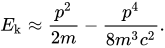
This suggests that the formulae for energy and momentum are not special and axiomatic, but concepts emerging from the equivalence of mass and energy and the principles of relativity.
General relativity
Using the convention that

where the four-velocity of a particle is

and  is the proper time of the particle, there is also an expression for the kinetic energy of the particle in general relativity.
If the particle has momentum

as it passes by an observer with four-velocity uobs, then the expression for total energy of the particle as observed (measured in a local inertial frame) is
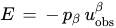
and the kinetic energy can be expressed as the total energy minus the rest energy:

Consider the case of a metric that is diagonal and spatially isotropic (gtt, gss, gss, gss). Since
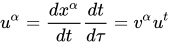
where vα is the ordinary velocity measured w.r.t. the coordinate system, we get

Solving for ut gives
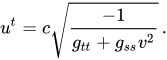
Thus for a stationary observer (v = 0)
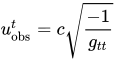
and thus the kinetic energy takes the form

Factoring out the rest energy gives:
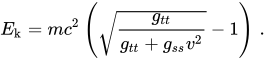
This expression reduces to the special relativistic case for the flat-space metric where

In the Newtonian approximation to general relativity
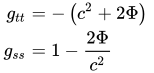
where Φ is the Newtonian gravitational potential. This means clocks run slower and measuring rods are shorter near massive bodies.


Comments
Post a Comment