Kinetic energy in quantum mechanics
In quantum mechanics, observables like kinetic energy are represented as operators. For one particle of mass m, the kinetic energy operator appears as a term in the Hamiltonian and is defined in terms of the more fundamental momentum operator . The kinetic energy operator in the non-relativistic case can be written as


Notice that this can be obtained by replacing by in the classical expression for kinetic energy in terms of momentum,


In the Schrödinger picture, takes the form where the derivative is taken with respect to position coordinates and hence

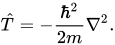
The expectation value of the electron kinetic energy, , for a system of N electrons described by the wavefunction is a sum of 1-electron operator expectation values:



where is the mass of the electron and is the Laplacian operator acting upon the coordinates of the ith electron and the summation runs over all electrons.


The density functional formalism of quantum mechanics requires knowledge of the electron density only, i.e., it formally does not require knowledge of the wavefunction. Given an electron density , the exact N-electron kinetic energy functional is unknown; however, for the specific case of a 1-electron system, the kinetic energy can be written as

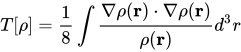
where is known as the von Weizsäcker kinetic energy functional.


Comments
Post a Comment